

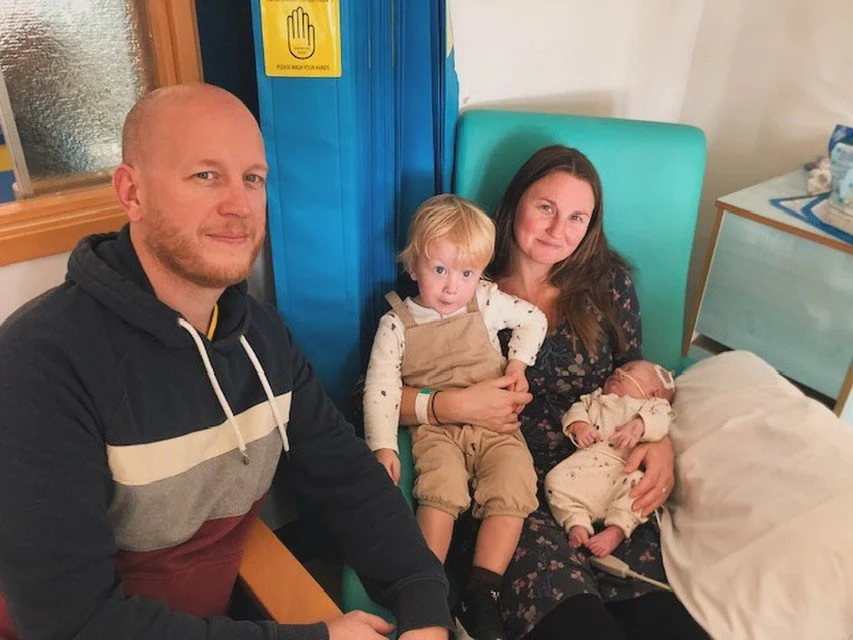
I'm a dad to three boys: Elijah, Ray and Hendrix. Ray was born on 3 October 2023 and died seven weeks later, on 20 November. I wanted to share something about his life and what it's been like being his dad, both during those seven weeks and in the years since.
When we found out my partner Steph was pregnant with Ray, we were over the moon. Life was going well, Elijah was about two and a half, and we were really looking forward to having another baby. But at our 20-week scan, the sonographer told us there was something wrong with his heart. After further appointments in Truro and Bristol, we found out he had a serious congenital heart condition called transposition of the great arteries, along with other defects.
The rest of the pregnancy was incredibly difficult, with lots of appointments, tests and uncertainty about what might happen. We tried to enjoy it as much as possible, but there was always that fear in the background.
Ray was supposed to be born in Bristol, but Steph was desperate for him to be Cornish. On 3 October, she started having contractions whilst we were out for a meal in Helston with Elijah. She insisted on finishing her food, convinced we had plenty of time. We didn't. After dropping Elijah at my parents', I drove frantically to Truro hospital, getting stuck behind what felt like every tractor in Cornwall. We only just made it.
Ray arrived very quickly, with a beautiful head of thick black hair. I remember holding him and feeling his warm little body against mine. We hadn't settled on a name, but I spotted the name Ray on a piece of hospital equipment and said, "He looks like a Ray." And that was that.
A specialist ambulance took him to Bristol that night, and we followed the next day. Ray would spend his entire life in hospital.
Those seven weeks were a mixture of hope, fear and exhaustion. There were times when we genuinely thought he was going to come home. I remember telling colleagues in a meeting that he might be discharged the following week.
And amongst everything that was happening medically, we got to know our little boy. He had lovely floppy ears with little indentations in them, funny little mouth movements, and he absolutely loved his milk. If the nurses were late feeding him, he'd get really ratty and make these little growling and yelping noises to let them know he wasn't happy.
I used to talk to him about his big brother, our family, the beach and the harbour in Porthleven. We'd listen to Scunthorpe United matches together, and I'd celebrate the goals with him. I'd tell him he might be a footballer one day, although he could be anything he wanted.
One of my favourite memories is Elijah coming to Bristol to meet him. I filmed him walking down the corridor, so excited to see his little brother. Ray was in a clear plastic cot with breathing support, and Elijah climbed straight in beside him, shoes and all. I was worried about infection, but the nurses told me it was fine. Looking back, I wish I'd relaxed a bit more and just enjoyed it. It was the first time the four of us had been together, and one of the only times.
It was incredibly difficult being separated as a family. Steph was mostly in Bristol, Elijah was in Cornwall with my parents and other family, and I was travelling backwards and forwards trying to work and see both boys. I always felt like I was leaving somebody behind.
When Ray was about five and a half weeks old, he had his first operation. Afterwards, he struggled to recover and developed a serious complication that the doctors couldn't fully explain. His fingers started turning black, and there were concerns about sepsis. They managed to stabilise him, but I remember telling my brother over lunch that I didn't think Ray was going to come out of hospital.
Not long afterwards, I was back in Cornwall and had just spent a lovely evening with Elijah. I'd put him to bed when Steph rang at about half ten to say Ray was critically ill and might not survive the night.
I had to wake Elijah, dress him and take him to my parents' house. He was screaming and so upset that I was leaving again. That was absolutely devastating. I then drove three and a half hours to Bristol, imagining Ray dying, his funeral and what life without him might be like.
Ray survived that night, and over the weekend there were some signs of improvement. The doctors said they'd do a brain scan on Monday to check whether he'd suffered any damage. One of the consultants was optimistic.
Steph and I spent that morning wandering around Bristol, trying to distract ourselves whilst we waited. When we got the call to return, we were taken into a room with the consultants and told the scans showed no brain activity and there was nothing more they could do.
I remember Steph asking, "What does that mean?"
My immediate response was to ask how quickly we could let him go. I've questioned that reaction many times since and wondered whether part of it was selfish, because we'd all been through so much. But I also couldn't bear to see Ray suffer anymore. He was heavily sedated, surrounded by machines, and his little body had been through so much.
The staff moved us into a private room where we could spend his final moments together. I took my top off so I could hold him skin to skin. We sat on the bed, passed him between us, took photographs and cuddled him.
I remember trying really hard to be present. I whispered to him about how much he was loved by his mum, dad, brother and all his family. I told him about the beach and the sea, and that I'd see him again one day.
Then he seemed to let out a little sigh. I looked at the monitor and saw a straight line. I called the nurse and asked, "Is that it? Is he gone?"
Afterwards, we helped wash him and were able to dress him properly for the first time. We were also given a little keepsake, which Steph and I kissed on either side. It was buried with him, so he's always got his mummy and daddy's kisses.
I remember walking back up the hill to our accommodation afterwards, looking at the dark sky and the stars, feeling this incredible heaviness and emptiness. We got a pizza and debated whether to drive straight home, but decided to stay the night.
I barely slept. I just kept waking up, thinking about Ray and praying for him. That went on for months.
When we got home, we collected Elijah and went to Marazion Beach together. Those first few months were absolutely brutal. The sadness, depression, brain fog and lack of sleep were unlike anything I'd experienced. Sometimes I'd wake up and, for a second, forget what had happened. Then it would hit me all over again.
I'd also have these strange swings between feeling completely broken and almost invincible, as though I'd been through the worst thing imaginable and nothing else could touch me.
Little things would set me off. I remember taking an egg out of the box one morning and seeing a tiny white feather on it. For some reason, that would just break me.
I was determined not to hide away, though. I'd take Elijah to nursery, go shopping and carry on getting out of the house. Sometimes I'd cry in public, but I really didn't care. The pain I was experiencing was so much greater than any discomfort somebody else might feel seeing me upset.
I've had OCD since childhood, and losing Ray made it significantly worse. Having the intrusive thoughts and compulsions on top of the grief and trauma was excruciating at times. Even though I was a counsellor and understood mental health, it didn't make it any easier to deal with when I was in the middle of it.
A lot of things that had previously been important to me disappeared. Fitness, music, meditation and Buddhism had all been big parts of my life, but I lost interest in them. I was just trying to survive each day.
One of the hardest things was how lonely it felt. I remember being at Ray's funeral and feeling as though I was floating in space, attached to a spaceship by a cable, and somebody had cut it. I was just drifting off into the darkness.
People were supportive initially, but as time went on, many stopped asking about Ray or mentioning his name. That was difficult. I wanted people to talk about him. I still do.
People would often ask how Steph was, and I wanted her to have all the support she could get. But I was grieving too. I think it's easy for dads to become the person who's expected to support everybody else, even when they're falling apart themselves.
Steph and I were incredibly close immediately after Ray died, but things became more difficult as time went on. I had to return to work whilst she still had months of maternity leave. We were grieving differently, and sometimes I didn't know how to help her when I was struggling so much myself. I remember sleeping downstairs on the sofa because I couldn't sleep properly and wanted the television nearby, and sometimes hearing her crying upstairs. It was heartbreaking.
I found some comfort in reading about other fathers who'd lost children, particularly Rob Delaney's book about his son Henry. I also ran a half marathon and raised money in Ray's memory. Having something practical to focus on helped.
Gradually, I began noticing small changes. I remember waking up one morning, perhaps three months after Ray died, and realising he hadn't been my first thought. When I remembered, I felt terribly guilty, as though I'd somehow forgotten him.
But over time, I began to understand that I could have moments of happiness without loving Ray any less. Little pockets of joy started appearing alongside the sadness. That was something I'd never really understood about grief before.
I also had EMDR therapy, which helped with the trauma and OCD. But grief is still very much part of my life, particularly between October and Christmas. Ray was born on 3 October, died on 20 November, and his funeral was on 20 December. It's a difficult few months every year.
When Steph became pregnant with Hendrix, we were still waiting for genetic tests because doctors had been investigating whether Ray might have had HLH, a serious immune condition that can sometimes be inherited. Thankfully, the tests came back clear, which was an enormous relief.
Hendrix was born in November 2024, and becoming his dad was fantastic.
But there are moments when I watch Elijah and Hendrix playing, hugging each other or sitting on the sofa watching television, and I really notice that somebody is missing. There should be three of them. I don't think that sadness will ever completely go away.
We make sure Ray is part of our family. We talk about him with Elijah and will do the same with Hendrix as he grows up. We take the children out of school on Ray's birthday and spend the day together. Every night before bed, I look at his photograph and pray for him.
My counselling practice, There Is a Light Therapy, is named after The Smiths song There Is a Light That Never Goes Out. It was the first song I listened to after Ray died, and it makes me feel incredibly connected to him.
More recently, I've also found my way back to meditation. When I practise being really present, it sometimes takes me back to those final moments holding Ray, when I was trying to take in every second I had with him. I find that connection really comforting.
Losing Ray is also a big part of why I now support other fathers who've experienced baby loss. I know how lonely it can feel, and I wouldn't want another dad to think he has to manage all of that pain on his own. You can be trying your hardest to support your family whilst completely crumbling underneath.
If there's anything I'd want another bereaved dad to know, it's that you don't have to grieve in a particular way. It's okay to cry, to ask for support, to struggle, and eventually to find some enjoyment in life again. None of that means you've forgotten your child.
When people ask how many children I have, I always say three. Sometimes that means explaining that one of my sons died, but it's important to me that Ray is acknowledged.
He was here for seven weeks. He was loved, he fought incredibly hard, he had his own funny little personality, and we're so proud of him.
I try to honour him every day, both in our family and through the work I do supporting others.
I'm still his dad, and I always will be.
